Tuesday, August 5, 2008

Zune Marketplace content coming to Nokia mobile phones?

Whispers roaming the net wave say that a Microsoft source claims Nokia are working with Microsoft to integrate the Zune Marketplace into Nokia mobile phones.

Now as always these sorts of rumours need to be taken with a touch of salt until some hard facts come out. But it appears that Nokia and Microsoft have teams to search for a way to offer Zune Marketplace content on Nokia’s non-smartphone handsets, which at present due to its protected Microsoft format doesn’t work outside Zune portable media players.

We all know Nokia made a hug amount of low end mobile phones, and if Microsoft’s Zune contents could be integrated, it could look as if Microsoft is mounting a two front war against the Apple iPhone with Windows based smartphones and Nokia non-smartphones.

Apparently the Microsoft source has denied all knowledge of a possible Zune phone hardware development, and says: “if there is a zune phone I don’t know about it.”

The mysterious source also states that any deal between Microsoft and Nokia would not be exclusive.

Source – zunescene

Technorati Tags: , , , , ,

Rumour: Nokia to integrate its phones with Zune Marketplace

The blogosphere’s been going mad overnight with a rumour that Nokia and Microsoft are working together to integrate the latter’s Zune Marketplace store with the former’s technology. “The joint development is directed at content delivery rather than a hardware device,” claims Zune Scene, which posted the initial story. In other words, Nokia isn’t making a ZunePhone, but may be allowing the Zune Marketplace store onto its existing handsets. The problem with this rumour is that Nokia has its own high-profile (and costly) content offering, Ovi (not to mention the Nokia Music Store), so how Zune Marketplace fits with that is anyone’s guess.

From : http://musically.com/

Technorati Tags: , , ,

Intel takes aim at Nvidia, AMD’s ATI

Intel is wading into the graphics chip market and its wake could roil Nvidia and AMD’s ATI.

On Monday, Intel is disclosing details (Techmeme) about Larrabee, a chip that will have stand alone graphics processing and aim for the gaming market. While Nvidia and AMD will poke holes in Larrabee the effort may miss the point. Intel can ruin pricing and squeeze its counterparts by just revealing its hand. Larrabee will land in 2009 or 2010.

Jon Peddie writes at Peddie Research:

Anyone not stuck in outer space or maximum security knows Intel is going to introduce a new chip code named Larrabee. At Siggraph they are going to reveal, after almost two years of teases and leaks, the architecture of the device.

It is not a GPU as many have mistakenly described it, but it can do most graphics functions, Intel says it can do all, we’ll have to wait for proof. Right now its slide-ware, but development systems are supposed to become available in November.

ATI and Nvidia will be very busy discrediting the device and pointing out its shortcomings. They should, given that Intel has all but ruined their share prices with disparaging comments about GPUs. Perhaps Intel needs to be reminded of some of its past triumphs; the Itanium and XScale come immediately to mind.

Peddie then examines whether there’s a market for a third graphic player and concludes yes.

Brooke Crothers also recaps Intel’s technology and new features such as software-based scheduling, execution threads, and ring networks.

Is Larrabee a guaranteed win? No, but Intel is likely to be very disruptive and squeeze both Nvidia and ATI.

From : http://blogs.zdnet.com/

Technorati Tags: , , , , , , , , ,

AMD, NVIDIA take battle to driver front

It appears that the fever pitch graphics battle between Santa Clara, CA based NVIDIA and Sunnyvale, CA based AMD, is about to take on a new form.

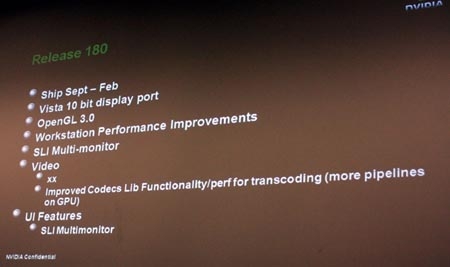
We reported details, some two weeks ago, regarding NVIDIA's 'Big Bang II' ForceWare Driver Software release, scheduled to be driving NVIDIA solutions from September.

Let's recap for a moment and review what NVIDIA has up its sleeve:

According to this story from TG Daily, more than one display unit will be able to utilise the power of multiple video cards, concurrently. This is termed as, SLI multi-monitor and is a feat that the company has been trying to achieve since 2004.

AMD, NVIDIA take battle to driver front


OpenGL 3.0 support, will attempt to bring the API kicking and screaming on to a level playing field with current technology, thanks to the implementation of support for new initiatives, brought to the table by DirectX 10 hardware over 18 months ago.

NVIDIA may also be playing catch-up with AMD by courting 'mix and match SLI', rather akin to AMD users being able to combine, for example, an HD 3870 X2 SKU with an HD 3870 solution, in CrossFireX configuration.

That isn't all NVIDIA is planning. The ForceWare R180 release is expected to also wrap up performance improvements for NVIDIA Quadro solutions, Windows Vista 10-bit DisplayPort support and a GPU accelerated video encoder, also known as the PureVideo Transcoder.

Now then, if information presented by HARDSPELL is accurate, AMD is also gearing up to unveil some surprises with the August release of its Catalyst 8.8 package.

AMD, NVIDIA take battle to driver front


Users can rejoice at claims of much improved CrossFireX performance, whilst PowerPlay 2.0 implementation does much to also pique interest.

Yet, it won't be only the much anticipated HD 4870 X2 which nets gains. It is cited, as an example, that 3D Mark Vantage results will receive credit interest of some 12% when utilising HD 4850 solutions in CrossFireX configuration.

PowerPlay 2.0 will also, it is claimed, make further inroads on reducing power consumption and heat output. TDP figures for HD 4850 solutions in CrossFireX configuration, are believed to receive a pleasant reduction from 211 W to 174 W at idle. Users will likely appreciate the associated temperature benefits too.

If you are eager to get your hands on an unsupported BETA version of these, perhaps, NVIDIA Big Bang II neutralizers, TechConnect Magazine has been kind enough to oblige.


From : http://www.tweaktown.com

Technorati Tags: , ,

Intel unveils graphics chip line

Intel has unveiled details of the chip that will spearhead its move into computer graphics.

It has revealed blueprints for the Larrabee chip that is scheduled to first appear in finished products in late 2009 or early 2010.

Larrabee will be a stand-alone graphics processor unlike the onboard chips it produces for many PC makers.

The move will bring Intel into direct competition with graphics specialists Nvidia and the ATI division of AMD.

Cheap supercomputer

Intel is aiming to put Larrabee into graphics cards for PCs that help show games and video in very high detail.

Like existing graphics chips from Nvidia and ATI, Larrabee is expected to have many separate processing cores onboard.

So far Intel has not said how many processing cores Larrabee will have onboard at launch or in subsequent generations. Future Nvidia and ATI graphics chips are expected to be made up of several hundred cores.

While Intel will initially target the PC graphics card market, it expects the raw computer power in the chip to help with oil and gas exploration, medical imaging and financial services in the future.

Many scientists and researchers already use coupled graphics cards as a desktop supercomputer that helps them carry out simulations far faster and cheaper than on a larger dedicated machine.

"Intel is showing its cards, but will have to deliver the products that live up to an attractive architecture," said Peter Kastner, an analyst with research firm Scott-Page.

Intel said it would release more details about Larrabee at the upcoming Siggraph computer graphics conference due to be held in Los Angeles from 12-15 August.

From : http://news.bbc.co.uk/

Technorati Tags: , , , , ,

Nintendo steps up its game

The Nintendo Wii’s Virtual Console has been a great way to revisit an impressive selection of vintage games, not only for past Nintendo systems but for one-time rival consoles like the Sega Genesis, Turbografx-16 and Neo Geo.

But while Wii owners have been able to enjoy some of their favorite old games again, Xbox 360 and PlayStation 3 gamers have been treated to virtual shelves full of new titles, some of them great.

WiiWare aims to fill that gap, and its online shop is stocked with original games unavailable on the other two consoles.

Here are a few of the 20 or so WiiWare games available so far; all of the games are rated E, for Everyone.

Final Fantasy Crystal Chronicles: My Life as a King

***

Publisher: Square Enix

Price: $15 (1,500 points)

Players take on the role of a young king who must rebuild and repopulate a barren kingdom with resources gathered by adventurers he dispatches to dungeons around the land. The pace is brisk, the controls are simple, and it’s quite a bit of fun to see the town grow as the heroes whom the king has hired and nurtured clear dungeons the player will never see. It’s an odd inversion of role-playing-game norms, but it works.

LostWinds

****

Publisher: Frontier Developments

Price: $10 (1,000 points)

A platform adventure game with a twist, LostWinds is the most intriguing of these early WiiWare offerings.

The nunchuk stick controls a young boy named Toku; the Wii Remote manipulates the wind in various ways to lift him up to platforms or over gaps, direct fire streams or waterspouts where they’re needed, slow Toku’s fall and so on. There are enemies to defeat, but the game is focused most on simply exploring, finding the next wind-based ability and solving puzzles to get to new areas.

Toki Tori

***

Publisher: Two Tribes B.V.

Price: $10 (1,000 points)

Finally we have Toki Tori, a puzzle game with hints of Lemmings. Players control a chubby yellow chick named Toki in his quest to gather all the eggs from each stage.

Toki can be moved with the nunchuk stick, or players may opt to simply point and click where they want the bird to go; either way, the stages are perilous and often have only one solution.

Thankfully, Toki has a selection of tools, like bridge lengths and teleporters, to help him make his way through each level.

From : http://www.star-telegram.com/

Technorati Tags: , , , , ,

Intel's Larrabee-- more and less than meets the eye

Intel announced on Monday that it will be presenting a paper at Siggraph 2008 about its "many-core" Larrabee architecture, which will be the basis of future Intel graphics processors.

The paper itself, however, has already been published, and I was able to get a copy of it. (Unfortunately, as you'll see at that link, the paper is normally available only to members of the Association for Computing Machinery.)


Intel's Larrabee includes "many" cores, on-chip memory controllers, a wide ring bus for on-chip communications, and a small amount of graphics-specific logic.


The paper is a pretty thorough summary of Intel's motives for developing Larrabee and the major features of the new architecture. Basically, Larrabee is about using many simple x86 cores-- more than you'd see in the central processor (CPU) of the system-- to implement a graphics processor (GPU). This concept has received a lot of attention since Intel first started talking about it last year.

The paper also answers perhaps the biggest unanswered question about Larrabee-- what are the cores, and how can Intel put "many" of them on a chip when desktop CPUs are still moving from 2 to 4 cores?

Intel describes the Larrabee cores as "derived from the Pentium processor," but I think perhaps this is an oversimplification. The design shown in the paper is only vaguely Pentium-like, with one execution unit for scalar (single-operation) instructions and one for vector (multiple-operation) instructions.


The Larrabee core contains only two execution units: one for scalar operations, one for vector operations.


That's the basic answer: Larrabee cores just have less going on. A quad-core desktop processor might have six or more execution units, and a lot of special logic to let it reorder instructions and execute code past conditional branches just in case it can guess the direction of the branch correctly. This complexity is necessary to maximize performance in a lot of desktop software, but it's not needed for linear, predictable code-- which is what we usually find in 3D-rendering software.

But the vector unit in Larrabee is much more powerful than anything in older Intel processors-- or even in the current Core 2 chips-- because 3D rendering needs to do a lot of vector processing. The vector unit can perform 16 single-precision floating-point operations in parallel from a single instruction, which works out to 512 bits wide-- great for graphics, though it would be overkill for a general-purpose processor, which is why the vector units in mainstream CPUs are 128 or 256 bits wide at most.

The new vector unit also supports three-operand instructions, probably including the classic "A * B + C" operation that is so common in many applications, including graphics. With three operands and two calculations per instruction, the peak throughput of a single Larrabee core should be 32 operations per cycle, and that's just what the paper claims.

I say "probably" because the Siggraph paper doesn't describe exactly what operations will be implemented in the vector unit, but I suspect this part of the Larrabee design is related to Intel's Advanced Vector Extensions, announced last April. The first implementations of AVX for desktop CPUs will apparently begin with a 256-bit design, another indication of how unusual it is for Larrabee to have a 512-bit vector unit.

Intel also built four-way multithreading into the Larrabee cores. Each Larrabee core can save all the register data from four separate threads in hardware, so that most thread-switch operations can be performed almost instantly rather than having to save one set of registers to main memory and load another. This approach is a reasonable compromise for reducing thread-switching overhead, although it probably consumes a significant amount of silicon.

Note that this kind of multithreading in Larrabee is very different from the Hyper-Threading technology Intel uses on Pentium 4, Atom, and future Nehalem processors. Hyper-Threading (aka simultaneous multi-threading) allows multiple threads to execute simultaneously on a single core, but this only makes sense when there are many execution units in the core. Larrabee's two execution units are not enough to share this way.

All of these differences prove rather conclusively that Larrabee's cores are not the same as the cores in Intel's Atom processors (also known as Silverthorne). That surprised me; the Atom core seemed fairly appropriate for the Larrabee project. All that really should have been necessary was to graft a wider vector unit onto the Atom design. But now I suppose the Atom and Larrabee projects have been completely independent from one another all along.

Intel won't say how many cores are in the first chip. The paper describes an on-chip ring network that connects the cores. The network is 512 bits wide. Interestingly, the paper mentions that there are two different ring designs-- one for Larrabee chips with up to 16 cores, and one for larger chips. That suggests Intel has chips planned with relatively small numbers of cores, possibly as few as 4 or 8. Such small implementations might be appropriate for Intel's future integrated-graphics chip sets, but as such they will be very slow by comparison with contemporary discrete GPUs, just as Intel's current products are.

Larrabee provides some graphics-specific logic in addition to the CPU cores, but not much. The paper says that many tasks traditionally performed by fixed-function circuits, such as rasterization and blending, are performed in software on Larrabee. This is likely to be a disadvantage for Larrabee, since a software solution will inevitably consume more power than optimized logic-- and consume computing resources that could have been used for other purposes. I suspect this was a time-to-market decision: tape out first, write software later.

The paper says Larrabee does provide fixed-function logic for texture filtering because filtering requires steps that don't fit as well into a CPU core. I presume there's other fixed-function logic in Larrabee, but the paper doesn't say.

Larrabee's rendering code uses binning, a technique that has been used in many software and hardware 3D solutions over the years, sometimes under names such as "tiling" and "chunking." Binning divides the screen into regions and identifies which polygons will appear in each region, then renders each region separately. It's a sensible choice for Larrabee, since each region can be assigned to a separate core.

Binning also reduces memory bandwidth, since it's easier for each core to keep track of the lower number of polygons assigned to it. The cores are less likely to need to go out to main memory for additional information.

The paper gives some performance numbers, but they're hard to interpret. For example, game benchmarks were constructed by running a scene through a game, then taking only widely separated frames for testing on the Intel design. In the F.E.A.R. game, for example, only every 100th frame was used in the tests. This creates an unusually difficult situation for Larrabee; there's likely to be much less reuse of information from one frame to the next.

But given that limitation of the test procedure, the results don't look very good. To render F.E.A.R. at 60 frames per second-- a common definition of good-enough gaming performance-- required from 7 to 25 cores, assuming each was running at 1GHz. Although there's a range here depending on the complexity of each frame, good gameplay requires maintaining a high frame rate-- so it's possible that F.E.A.R. would, in practice, require at least a 16-core Larrabee processor.

And that's about the performance of a 2006-vintage NVIDIA or AMD/ATI graphics chip. This year's chips are three to four times as fast.

In other words, unless Intel is prepared to make big, hot Larrabee chips, I don't think it's going to be competitive with today's best graphics chips on games.

Intel can certainly do that-- no other semiconductor company on Earth can afford to make big chips the way Intel can-- but that would ruin Intel's gross margins, which are how Wall Street judges the company. Also, Intel's newest processor fabs are optimized for high-performance logic, like that used in Core 2 processors. Larrabee runs more slowly, suggesting it could be economically manufactured on ASIC product lines... but Intel's ASIC lines are all relatively old, refitted CPU lines.

NVIDIA, by comparison, gets around this problem by designing its chips from the beginning to be made in modern ASIC factories, chiefly those run by TSMC. Although these factories are a generation behind Intel's in process technology, they're much less expensive to operate. So this may be a situation where Intel's process edge doesn't mean as much as it does in the CPU business.

The Larrabee programming model also supports non-graphics applications. Since it's fundamentally just a multi-core x86 processor, it can do anything a regular CPU can do. Intel's paper even uses Sun's term, Throughput Computing, for multi-core processing.

The Larrabee cores aren't nearly as powerful as ordinary notebook or desktop processors for most applications. Real Larrabee chips could be faster or slower than the 1GHz reference frequency used in the paper, but there's definitely only one execution unit for the scalar operations that make up the bulk of operating-system and office software. That means a single Larrabee core would feel slow even when compared with a Pentium III processor at the same frequency, never mind a Core 2 Duo.

But with such a strong vector unit, a Larrabee core could be very good at video encoding and other tasks, especially those that use floating-point math. At 1GHz, a single Larrabee core hits a theoretical 32 GFLOPS (32 billion floating-point operations per second). A 32-core Larrabee chip could exceed a teraflop-- roughly the performance of NVIDIA's latest GPU, the GTX 280, which has 240 (very simple) cores.

But I don't expect to see that kind of performance from the first Larrabee chips. The power consumption of a 32-core design with all the extra overhead required by x86 processing would be very high. Even with Intel's advantages in process technology, such a large Larrabee chip would probably be commercially impractical. Smaller Larrabee designs may find some niche applications, however, acting as number-crunching coprocessors much as IBM's Cell chips do in some systems.

And although a Larrabee chip could, in principle, be exposed to Windows or Mac OS X to act as a collection of additional CPU cores, that wouldn't work very well in the real world and Intel has no intention of using it that way. Instead, Larrabee will be used like a coprocessor. In that application, Larrabee's x86 compatibility isn't worth very much.

So-- what's Larrabee good for, and why did Intel bother with it?


I think maybe this was a science project that got out of hand. It came along just as AMD was buying ATI and so positioning itself as a leader in CPU-GPU integration. Intel had (and still has) no competitive GPU technology, but perhaps it saw Larrabee as a way to blur the line distinguishing CPUs from GPUs, allowing Intel to leverage its expertise in CPU design into the GPU space as well.

Intel may have paid too much attention to some of its own researchers, who have been touting ray tracing as a potential alternative to traditional polygon-order ray tracing. I wrote about this in some depth back in June ("Ray tracing for PCs-- a bad idea whose time has come"). But ray tracing merits just one paragraph and one figure in this paper, which establish merely that Larrabee is more efficient at ray tracing than an ordinary Xeon server processor. It falls well short of establishing that ray tracing is a viable option on Larrabee, however.

Future members of the Larrabee family may be good GPUs, but from what I can see in this paper, the first Larrabee products will be too slow, too expensive, and too hot to be commercially competitive. It may be several more years beyond the expected 2009/2010 debut of the first Larrabee parts before we find out just how much of Intel's CPU know-how is transferrable to the GPU market.

I'll be at Siggraph again this year, and I'll have more to say after I've read this paper through a few more times and had a chance to speak with some of the folks I know at AMD, NVIDIA, and other companies in the graphics market.


From : http://news.cnet.com/

Nintendo Responds To US Release Date Queries

Posted Tue, 05 Aug 2008 - By Damien McFerran

Following Monday’s US Virtual Console release debacle, Nintendo has responded to enquiries about how three different publishers were issuing statements claiming that their games would be coming out on the 4th, only for Nintendo to release two entirely different games instead.

Speaking to GoNintendo, the company had this to say:

A number of variables can affect a game’s release date. Therefore, the Wii-kly Update is the only authority for confirmed release dates of Virtual Console games.

If this is indeed the case, then why are publishers telling the general public that their games will be released? Surely if Nintendo is adamant that Wii owners should only consult the Wii-kly update for the correct news, they should be telling Capcom, Hudson and SNK Playmore to keep their collective mouths shut?

It doesn’t take a genius to realize that these companies MUST be given some kind of indication from Nintendo regarding potential release dates; otherwise they surely wouldn’t mention it.

Whatever is happening, there are a lot of very annoyed people in Virtual Console land right now and Nintendo seriously needs to address this issue. Either they tell publishers to zip it, or they start being a heck of a lot more open about upcoming releases.

Nintendo of Japan is able to do this, so why not Nintendo of America?

From : http://www.vc-reviews.com/

Technorati Tags: , ,