Analyst Opinion - We often talk about an iPhone killer, which clearly has not arrived yet. To date, the only company that has really put a crimp in iPhone sales is RIM, which posted strong growth during the first year the iPhone was available. RIM enjoys a very loyal following of users that, while they are not as vocal as their Apple counterparts, they very likely to buy another Blackberry - no matter how compelling other devices may be. And RIM appeals to the folks who buy most smart phones - business buyers - while the iPhone is still largely seen as an expensive consumer device.
RIM was always better at business and really didn’t get the whole entertainment thing. And, you have to admit, an initially crappy MobileMe made a joke out of Steve Jobs suggesting that Active Sync was a bad technology. Active Sync actually worked and RIM’s service is much more mature and trusted by enterprise buyers than Active Sync currently is.
Enter Slacker, which has an incredible service (my personal favorite at the moment) - one of the best ways to enjoy new tunes using a portable device. The only problem is the Slacker device kind of looks and works like something designed by Harley Davidson during their bad years. It does not look and feel like something a real CE vendor would bring to market, which means it is well out of Apple’s league right now.
But, combine the RIM hardware, particularly the new RIM Bold and Thunder with the Slacker Service and you have something interesting and exciting.
Building a better iPhone
There have been a number of really interesting competing products that have come to market over the last few months. The best until recently were the LG Dare and the Samsung Instinct. While I don’t know anyone who uses the Dare, I have spoken to several who have the Instinct and they love it but neither has the blend of services and hardware to translate into a true knockout blow. Both have advantages over the iPhone, but all three devices have really poor battery life (at least Samsung gives you a spare battery).
Recently Sprint and HTC launched the new Sprint HTC Touch Diamond, soon to be followed by the Touch Pro. Coupled with Sprint’s back end and bigger batteries, these devices actually have a number of advantages over the iPhone from smaller size and longer battery life to a better GPS and an Opera based browser. But the Sprint music service isn’t iTunes and the end-to-end experience, while arguably one of the best in the non-iPhone class, still is just competitive. It doesn’t really exceed the iPhone and does not really make up for the music a lot of folks have already invested in on iTunes. Now if they added the Zune music service… But they don’t and while they are overall the iPhone’s match they don’t beat the iPhone in enough areas to be truly better, just different.
The RIM Bold and Thunder coupled with Slacker have the possibility of beating the iPhone on almost all fronts, granted they won’t have Apple marketing or Steve Jobs, both of which have been critical to Apple’s success. But RIM has focused developers, it is vastly more focused on business applications (companies still buy the vast majority of phones in this class), and their end-to-end experience when coupled with a RIM server makes MobileMe look like a bad joke.
What really puts it over the top though is Slacker.
The Slacker difference
I’ve been using Slacker for some time and have become really hooked on this service. It learns your likes and dislikes based on the artists you select and builds custom channels for you of constantly refreshed music, either free with advertising (Google model) or at a nominal fee per month without. This is, to me, actually better than most subscription services, because I never have to manage my tracks or manually select or deselect songs I’m tired of on the service. Like TiVo, you vote on the songs you like and dislike and, over time, the service learns of your interests and updates your music based on how well it knows you.
After a few weeks with the service, I rarely get a track I don’t like and still the majority of tracks are constantly new and fresh with a few of my favorite songs constantly tossed in for good measure. Granted there is no real video yet, but video on any of these phones decreases battery life dramatically leaving you, with no juice for doing anything else anyway. But, RIM will eventually have to close this final gap and undoubtedly will do so with the services typically offered by the carriers that have it. TV on Verizon and Sprint has generally been better than the iPhone experience and I would expect they will show up on the Bold and Thunder as well.
Wrapping up
RIM has history of solving first quality and battery life. They have had service issues, but their phones have been rock solid and those service issues are now in RIM’s past while the Apple service issues (coupled with the related law suits) are still in our present.
With the right marketing, I think RIM could steal Apple’s thunder (pun intended) and provide a real alternative to the iPhone now that it has a music offering that is both different and arguably better for those that don’t like to manage music on their phone (and given the refresh rate for iPods I’m guessing there are a lot of you out there).
The RIM Bold with Slacker will be worth watching and it may, for many of us, be one of the best iPhone alternatives, along with the HTC Touch Diamond and Pro out there this year. Life is about choices, RIM and Slacker just made the smart phone market really interesting. I don’t expect iPhone fans to switch, but in the quest for new customers, this new RIM partnership is a winner. We’ll see if it plays out that way.
From : http://www.tgdaily.com/
Saturday, September 13, 2008
No sign of iPod fatigue with Nano
I brought a new iPod Nano to lunch the other day, partly to see how well it carries and, yes, partly to show off.
The new fourth-generation model, announced this week, returns the iPod Nano to its design roots: unlike the squat design of the previous incarnation, this one is tall and thin, with a rectangular screen that occupies more than half of the front of the device.
The body is curved aluminum, and it's very thin and very light — after putting it in my pocket, I almost forgot it was there.
The Nano is available in two configurations: 8 GB of storage for $149 or 16 GB for $199. Both models come in eight colors.
But the looks weren't necessarily the attraction at lunch. Now that Apple owns 73.4 percent of the music-player market, I wondered: Are people still interested in yet another device that plays music and video? Has iPod fatigue finally set in?
Apparently not. When I played a movie on the iPod Nano's incredibly sharp screen — rotated 90 degrees to take advantage of the widescreen aspect ratio, thanks to the Nano's new built-in accelerometer — I saw that familiar sense of wonder and curiosity that accompanied the introduction of the original iPod.
The accelerometer, which is also present in the iPhone and iPod Touch, adds several capabilities to the iPod Nano. It lets you view your music library in Cover Flow mode (as if you're flipping through the panels of an old jukebox).
It displays horizontal photos full screen when the device is held sideways. Videos automatically play in the widescreen orientation.
Having the accelerometer also provides the capability to take advantage of motion actions; the included Maze game relies on tipping the iPod every which way to guide a marble through a maze.
(Oddly, when playing a game in the widescreen orientation, the click wheel's functions are also rotated: pressing the Menu button performs the actions of the Previous button, the Next button acts as the Menu button, and so on. That behavior only seems to apply to game playing.)
The Nano has other tricks up its sleeve, too. Shake the device while music is playing and it switches to shuffle mode to play songs randomly. (When the screen is inactive or the hold button is enabled, shake-to-shuffle is disabled, so your music isn't randomized as you dash for the bus.)
A preference in iTunes activates spoken menus on the iPod Nano, so people with vision difficulties can navigate the menus. It also supports Apple's new Genius playlists (which I'll get to in a moment).
iPod Touch: Also announced this week was an updated iPod Touch, which I've decided that I deeply resent because it makes my svelte first-generation iPhone look chunky.
It's available in three configurations: 8 GB ($229), 16 GB ($299) and 32 GB ($399).
This model isn't much different from the previous one. It adds the Genius feature (really, I'm almost there) and built-in support for the Nike + iPod exercise system: The iPod Touch includes the radio that communicates with the shoe sensor that tracks your pace, removing the need for a bulky plug-in adapter.
It also ships with version 2.1 of the iPhone Touch software. Owners of existing iPod Touch models can upgrade from version 2.0 to 2.1 for free; upgrading from version 1.0 to 2.1 costs $9.95.
iTunes 8: The other major announcement was iTunes 8, a free download for Mac and Windows. In addition to support for the new iPods, iTunes features Genius, an intelligent music-recommendation tool.
When you select a song in your library and click the new Genius button, iTunes builds a playlist of songs it believes play well together. In my testing, Genius did pretty well, with a few odd picks.
Building a playlist around José González's "Heartbeats," a song featuring vocals over acoustic guitar, brought up a playlist that included the more rocking "I'll Bet You Look Good on the Dance Floor" by the Arctic Monkeys, for example.
You must first enable Genius, which compiles and uploads information about your library (but not any personal identifying information) to Apple, where the data is matched with millions of other users' data.
Once a week new algorithms — Apple calls them Genius Results — are downloaded to your computer to help improve the intelligence of the service.
The iPod Nano and iPod touch each contain a new Genius menu that can build a Genius playlist on the fly without connecting to iTunes.
A separate Genius Sidebar (which can be shown or hidden) provides a similar service, but uses the selected song to bring up suggestions at the iTunes Store.
Last, iTunes 8 heralds the introduction of high-definition versions of television shows, including shows from the prodigal network NBC, who pulled out of the iTunes Store last year allegedly over a pricing dispute.
From : http://seattletimes.nwsource.com/
The new fourth-generation model, announced this week, returns the iPod Nano to its design roots: unlike the squat design of the previous incarnation, this one is tall and thin, with a rectangular screen that occupies more than half of the front of the device.
The body is curved aluminum, and it's very thin and very light — after putting it in my pocket, I almost forgot it was there.
The Nano is available in two configurations: 8 GB of storage for $149 or 16 GB for $199. Both models come in eight colors.
But the looks weren't necessarily the attraction at lunch. Now that Apple owns 73.4 percent of the music-player market, I wondered: Are people still interested in yet another device that plays music and video? Has iPod fatigue finally set in?
Apparently not. When I played a movie on the iPod Nano's incredibly sharp screen — rotated 90 degrees to take advantage of the widescreen aspect ratio, thanks to the Nano's new built-in accelerometer — I saw that familiar sense of wonder and curiosity that accompanied the introduction of the original iPod.
The accelerometer, which is also present in the iPhone and iPod Touch, adds several capabilities to the iPod Nano. It lets you view your music library in Cover Flow mode (as if you're flipping through the panels of an old jukebox).
It displays horizontal photos full screen when the device is held sideways. Videos automatically play in the widescreen orientation.
Having the accelerometer also provides the capability to take advantage of motion actions; the included Maze game relies on tipping the iPod every which way to guide a marble through a maze.
(Oddly, when playing a game in the widescreen orientation, the click wheel's functions are also rotated: pressing the Menu button performs the actions of the Previous button, the Next button acts as the Menu button, and so on. That behavior only seems to apply to game playing.)
The Nano has other tricks up its sleeve, too. Shake the device while music is playing and it switches to shuffle mode to play songs randomly. (When the screen is inactive or the hold button is enabled, shake-to-shuffle is disabled, so your music isn't randomized as you dash for the bus.)
A preference in iTunes activates spoken menus on the iPod Nano, so people with vision difficulties can navigate the menus. It also supports Apple's new Genius playlists (which I'll get to in a moment).
iPod Touch: Also announced this week was an updated iPod Touch, which I've decided that I deeply resent because it makes my svelte first-generation iPhone look chunky.
It's available in three configurations: 8 GB ($229), 16 GB ($299) and 32 GB ($399).
This model isn't much different from the previous one. It adds the Genius feature (really, I'm almost there) and built-in support for the Nike + iPod exercise system: The iPod Touch includes the radio that communicates with the shoe sensor that tracks your pace, removing the need for a bulky plug-in adapter.
It also ships with version 2.1 of the iPhone Touch software. Owners of existing iPod Touch models can upgrade from version 2.0 to 2.1 for free; upgrading from version 1.0 to 2.1 costs $9.95.
iTunes 8: The other major announcement was iTunes 8, a free download for Mac and Windows. In addition to support for the new iPods, iTunes features Genius, an intelligent music-recommendation tool.
When you select a song in your library and click the new Genius button, iTunes builds a playlist of songs it believes play well together. In my testing, Genius did pretty well, with a few odd picks.
Building a playlist around José González's "Heartbeats," a song featuring vocals over acoustic guitar, brought up a playlist that included the more rocking "I'll Bet You Look Good on the Dance Floor" by the Arctic Monkeys, for example.
You must first enable Genius, which compiles and uploads information about your library (but not any personal identifying information) to Apple, where the data is matched with millions of other users' data.
Once a week new algorithms — Apple calls them Genius Results — are downloaded to your computer to help improve the intelligence of the service.
The iPod Nano and iPod touch each contain a new Genius menu that can build a Genius playlist on the fly without connecting to iTunes.
A separate Genius Sidebar (which can be shown or hidden) provides a similar service, but uses the selected song to bring up suggestions at the iTunes Store.
Last, iTunes 8 heralds the introduction of high-definition versions of television shows, including shows from the prodigal network NBC, who pulled out of the iTunes Store last year allegedly over a pricing dispute.
From : http://seattletimes.nwsource.com/


Virginia Anti-Spam Law Overturned, Spammer Walks
The Virginia Supreme Court today struck down a state anti-spam law, saying the statute violated the First Amendment right to free and anonymous speech. The decision also tossed out the conviction of a North Carolina man once described as one of the most prolific spammers.
The Washington Post's Tom Jackman writes:
"Everyone agreed Jaynes was incredibly guilty, but the issue was the peculiarity of the Virginia law in that it could be read to apply to people who were sending junk e-mail but not quite as naughtily as Jaynes was doing it," Levine said. "In the United States, we have this ancient tradition where political and religious speech are very strongly protected, but the Virginia law applied equally to all speech, commercial or not."
A copy of the court's decision is available at this link here.
At least 38 states have laws regulating spam, according to the National Conference of State Legislatures. Levin said one reason anti-spam activists prefer suing spammers under state law is that the federal statute forces the plaintiff to pay the defendant's legal fees if the case is tossed out or decided in favor of the accused spammer.
Last year, a judge dismissed a junk e-mail lawsuit brought by serial anti-spam litigator James Gordon against e-mail marketer Virtumundo, ordering Gordon to pay Virtumundo $111,000 in legal fees and court costs.
Jon Praed, an attorney with the Arlington, Va., based Internet Law Group who has sued his share of spammers, lambasted the court's decision, saying it was akin to giving burglars the constitutional right to break into Virginia homes as long as they recite the Gettysburg Address while crossing the threshold.
"Every kindergartner learns the idea of keeping your hands to yourself," Praed said. "Does the Constitution really requires us all to post 'No Trespassing' signs on our homes -- or our mail servers -- to remind the world the dwelling isn't open to the public and the mail server is not a soapbox to be used and abused by anyone who thinks they have something to say?"
Levin said state lawmakers could easily fix the law simply by restricting the statute to commercial e-mail.
For his part, Virginia Attorney General Bob McDonnell said he intends to appeal the case to the U.S. Supreme Court.
"Today, the Supreme Court of Virginia has erroneously ruled that one has a right to deceptively enter somebody else's private property for purposes of distributing his unsolicited fraudulent emails. I respectfully but fervently disagree," McDonnell said in a written statement. "We will take this issue directly to the Supreme Court of the United States. The right of citizens to be free from unwanted fraudulent emails is one that I believe must be made secure."
Jaynes, who has been under house arrest in Loudoun since his conviction in 2004, could not be immediately reached for comment.
From : http://voices.washingtonpost.com/
The Washington Post's Tom Jackman writes:
The ruling, arising from the Loudoun County criminal prosecution of Jeremy Jaynes of Raleigh, N.C., was also remarkable because the Supreme Court reversed itself: Just six months ago, the same court upheld the anti-spam law by a 4-3 margin. But Jaynes's attorneys asked the court to reconsider, typically a long shot in appellate law, and the court not only reconsidered but changed its mind.John Levine, president of the Coalition Against Unsolicited Commercial Email (CAUCE), said the court overturned the law because it sought to outlaw all forms of unsolicited e-mail, not just commercial junk mail. In contrast, he said, the federal CAN-SPAM Act limits the restriction to messages used to promote a business or other financial gain.
Jaynes was convicted in 2004 of sending tens of thousands of e-mails through America Online servers in Loudoun. He was the first person tried under the law, enacted in 2003, and Loudoun Circuit Court Judge Thomas D. Horne sentenced him to nine years in prison.
"Everyone agreed Jaynes was incredibly guilty, but the issue was the peculiarity of the Virginia law in that it could be read to apply to people who were sending junk e-mail but not quite as naughtily as Jaynes was doing it," Levine said. "In the United States, we have this ancient tradition where political and religious speech are very strongly protected, but the Virginia law applied equally to all speech, commercial or not."
A copy of the court's decision is available at this link here.
At least 38 states have laws regulating spam, according to the National Conference of State Legislatures. Levin said one reason anti-spam activists prefer suing spammers under state law is that the federal statute forces the plaintiff to pay the defendant's legal fees if the case is tossed out or decided in favor of the accused spammer.
Last year, a judge dismissed a junk e-mail lawsuit brought by serial anti-spam litigator James Gordon against e-mail marketer Virtumundo, ordering Gordon to pay Virtumundo $111,000 in legal fees and court costs.
Jon Praed, an attorney with the Arlington, Va., based Internet Law Group who has sued his share of spammers, lambasted the court's decision, saying it was akin to giving burglars the constitutional right to break into Virginia homes as long as they recite the Gettysburg Address while crossing the threshold.
"Every kindergartner learns the idea of keeping your hands to yourself," Praed said. "Does the Constitution really requires us all to post 'No Trespassing' signs on our homes -- or our mail servers -- to remind the world the dwelling isn't open to the public and the mail server is not a soapbox to be used and abused by anyone who thinks they have something to say?"
Levin said state lawmakers could easily fix the law simply by restricting the statute to commercial e-mail.
For his part, Virginia Attorney General Bob McDonnell said he intends to appeal the case to the U.S. Supreme Court.
"Today, the Supreme Court of Virginia has erroneously ruled that one has a right to deceptively enter somebody else's private property for purposes of distributing his unsolicited fraudulent emails. I respectfully but fervently disagree," McDonnell said in a written statement. "We will take this issue directly to the Supreme Court of the United States. The right of citizens to be free from unwanted fraudulent emails is one that I believe must be made secure."
Jaynes, who has been under house arrest in Loudoun since his conviction in 2004, could not be immediately reached for comment.
From : http://voices.washingtonpost.com/
First Look: iPhone 2.1
Phone 2.0 brought a lot of cool features with it, but it also brought a lot of bugs. Performance was slow, calls dropped often, and the battery life was less than impressive—and that’s just off the top of my head.
Apple promised on Tuesday that the iPhone 2.1 update, released Friday morning, would save us all from the iPhone 2.0’s sins, but as it turns out, the software brings with it more than just bug fixes. Apple also took the time to sneak in a few new features along with its extensive mea culpa.
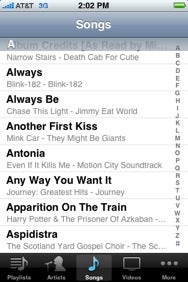 Name that Tune: The iPhone's iPod application now displays artists and albums along with the track name.
When browsing Podcasts or Videos, the iPhone 2.1 software also gives you more information. Rather than displaying a blue dot next to a video or podcast that hasn’t been listened to or watched, the software now also shows a blue half-moon for videos that have been started but not finished. And in the case of podcasts, it will also tell you how much time remains from the point at which you stopped listening. Telling episodes apart is easier too, since the iPhone will also show you when episodes were published, the episode name, and the full runtime.
Once you’ve created a Genius playlist—which, unlike iTunes, is limited to 25 tracks on the iPhone—you can save it, refresh it with new songs, or create a Genius playlist based on a different song on your iPhone. Saving the playlist will add it to your existing playlists; it’ll be named after the song on which the playlist was based and there’ll be a Genius icon next to it. There’s also a “Genius” playlist that permanently resides at the top of the playlist list and shows the last playlist you generated.
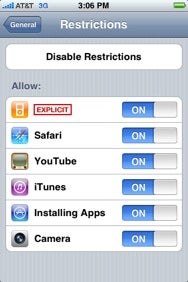 Don't Shoot: Parental Restrictions now allows you to disable the iPhone's Camera.Outside of the iPod app, there are a few other new features sprinkled around the iPhone OS update. For example, the Parental Restrictions setting now allows you to turn off access to the iPhone’s camera, which not only removes the Camera application from the Home screen, but also disallows access from third-party applications that implement camera features.
For the security conscious, the Passcode Lock section of Settings now offers an option to erase all data on the iPhone after 10 failed attempts at entering the passcode (which presumably works—you’ll pardon me if I didn’t test its effectiveness). Apple also made a handful of security updates, including preventing applications from viewing each other’s data and closing a loophole with the Emergency Call feature of the Passcode Lock.
Those who use the iPhone’s stock earbuds (or have a third-party headphone adapter with a click control) will also find that in addition to clicking once to play or pause music and twice to skip to the next track, a triple-click will now jump back to the previous track.
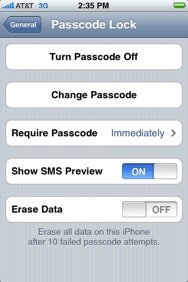 Eraserhead: A new Erase Data lets the security conscious protect their information with extreme prejudice.In addition, the SMS application will now alert you up to two additional times if you don’t acknowledge an incoming text message. And Apple’s also changed the icon in the menu for cell networks: instead of displaying white text in a blue box, the icons for 3G, EDGE, and GPRS are now just white text on a black background or blue text on a gray background, depending on the context.
In terms of bug fixes, Apple appears to have delivered a lot of the stability that was missing from the 2.0 iPhone software. As promised, iTunes backups take substantially less time than they did previously; installing third-party applications is definitely faster, even over 3G; and loading or searching contacts is definitely snappier.
Other bug fixes aren’t quite as easily tested in the short-term, like better battery life, fewer dropped calls, and fewer hangs and crashes, but you can bet that we’ll be keeping an eye on whether or not they measure up to Apple’s claims.
From : http://www.macworld.com/
Apple promised on Tuesday that the iPhone 2.1 update, released Friday morning, would save us all from the iPhone 2.0’s sins, but as it turns out, the software brings with it more than just bug fixes. Apple also took the time to sneak in a few new features along with its extensive mea culpa.
Name that Tune: The iPhone's iPod application now displays artists and albums along with the track name. Music to your ears
The most significant feature changes in iPhone 2.1 come in the device’s iPod application. For one thing, in most views when displaying a list of tracks, the iPod app borrows a page from Apple’s Remote application, showing the artist and album in smaller text underneath.When browsing Podcasts or Videos, the iPhone 2.1 software also gives you more information. Rather than displaying a blue dot next to a video or podcast that hasn’t been listened to or watched, the software now also shows a blue half-moon for videos that have been started but not finished. And in the case of podcasts, it will also tell you how much time remains from the point at which you stopped listening. Telling episodes apart is easier too, since the iPhone will also show you when episodes were published, the episode name, and the full runtime.
Real Genius
The biggest addition to the iPod application is, of course, the new Genius feature that pervades all of the new products that Apple introduced this week. (Our iTunes 8 review explains the Genius in greater depth.) You’ll need to sync your iPhone to your computer before you get access to Genius, but once it’s installed creating a Genius playlist is easy: When listening to a song, tap the album art to show the scrubber panel. Nestled in between the shuffle and repeat controls is the Genius’s “atom” icon. Tapping that will generate a Genius playlist based on the playing track.Once you’ve created a Genius playlist—which, unlike iTunes, is limited to 25 tracks on the iPhone—you can save it, refresh it with new songs, or create a Genius playlist based on a different song on your iPhone. Saving the playlist will add it to your existing playlists; it’ll be named after the song on which the playlist was based and there’ll be a Genius icon next to it. There’s also a “Genius” playlist that permanently resides at the top of the playlist list and shows the last playlist you generated.
Everything else
Don't Shoot: Parental Restrictions now allows you to disable the iPhone's Camera.For the security conscious, the Passcode Lock section of Settings now offers an option to erase all data on the iPhone after 10 failed attempts at entering the passcode (which presumably works—you’ll pardon me if I didn’t test its effectiveness). Apple also made a handful of security updates, including preventing applications from viewing each other’s data and closing a loophole with the Emergency Call feature of the Passcode Lock.
Those who use the iPhone’s stock earbuds (or have a third-party headphone adapter with a click control) will also find that in addition to clicking once to play or pause music and twice to skip to the next track, a triple-click will now jump back to the previous track.
Eraserhead: A new Erase Data lets the security conscious protect their information with extreme prejudice.In terms of bug fixes, Apple appears to have delivered a lot of the stability that was missing from the 2.0 iPhone software. As promised, iTunes backups take substantially less time than they did previously; installing third-party applications is definitely faster, even over 3G; and loading or searching contacts is definitely snappier.
Other bug fixes aren’t quite as easily tested in the short-term, like better battery life, fewer dropped calls, and fewer hangs and crashes, but you can bet that we’ll be keeping an eye on whether or not they measure up to Apple’s claims.
From : http://www.macworld.com/
Google bends to Chrome privacy criticism
September 9, 2008 (Computerworld) Reacting to criticism that its new Chrome browser was essentially acting as a keylogger, potentially recording users' every keystroke, Google Inc. yesterday said it would render anonymous the data it collects from the browser within 24 hours.
A privacy expert said the change's impact couldn't be gauged without knowing exactly how Google will "anonymize" the data it records as users type in Chrome's "OmniBox," the name given to the browser's combination address bar-search bar. Google has taken heat over the "Google Suggest" feature used within OmniBox since it launched Chrome last week. The Suggest feature automatically lists related search queries and popular Web destinations based on the text typed into the OmniBox. Suggest works by logging users' keystrokes -- not just in the OmniBox, but since late last month in Google's primary search field -- and offering the most likely sites or searches based on a blend of popularity and the search company's own algorithms.
Suggest transmits those keystrokes to Google's servers, as the feature's FAQ acknowledges. "Just as E.T. needs to phone home in order to get a spaceship to pick him up, Google Suggest needs to talk to Google while you type in order to offer suggestions to you," the FAQ reads.
While all keystrokes typed into Chrome's OmniBox are sent to Google, the vast majority aren't permanently recorded, but instead are discarded as soon as suggestions are returned to the browser. About 2% of the time, however, the keystrokes are recorded, along with associated data such as the IP address of the user who entered those keystrokes.
Previously, Google said it needed that data to monitor and improve Suggest. On Monday, the company announced it would change how long it keeps the data logged from Suggest.
"Given the concerns that have been raised about Google storing this information, and its limited potential use, we decided that we will anonymize it within about 24 hours, basically, as soon as we practically can," said Urs Holzle, Google's senior vice president for operations, in an entry to the company's blog late Monday.
"All data retention is a balance between user privacy and trust on the one hand, and security and innovation on the other," argued Holzle. "In the case of Google Suggest, we decided it's possible to provide a great service while anonymizing data almost immediately."
Google Suggest, which had been in development since 2004, began rolling out to Google's search engine late last month. Before that, it was widely used by Google Toolbar, Mozilla Corp.'s Firefox and Apple Inc.'s iPhone.
The logging, transmitting and recording of keystrokes, however, returned to the forefront when Google released Chrome a week ago. What sparked the criticism over Chrome was the everything-in-one-place nature of the browser's OmniBox, said Alissa Cooper, the chief computer scientist at the Center for Democracy and Technology. Unlike other browsers, which separate the address bar -- where users type URLs -- from the search bar, Chrome combines the two.
"It's the URLs that sparked the criticism, and the change by Google," said Cooper. "Users were faced with Google retaining all of their search logs and all of the URLs they were typing."
Nor was Cooper sure that Google's new promise to anonymize the recorded data within 24 hours is enough. "That's a good step, but that doesn't mean that all those logs are rendered anonymous," she said, pointing out that Google says it anonymizes its server logs, for instance, when it only partially deletes IP addresses and cookies.
"It will really depend on the mechanism Google uses to anonymize those logs," Cooper said. "The impact this has on privacy will only become clear when we know how they render the data anonymous."
Chrome users can disable Google Suggest by right-clicking the OmniBox, then selecting "Edit search engines" and clearing the check box beside "Use a suggestion service to help complete searches and URLs typed in the address bar."
From : http://www.computerworld.com/
Mozilla’s Upcoming Firefox 3.1 To Offer Privacy Mode As Well
Since the release of Google Chrome, every browser maker has entered in an emergency mode and it seems like Mozilla is paying attention to what is happening with the competition.
Also, the beta 2 version of Internet Exploerer 8, released late last month, features a full-fledged privacy mode which will prevent the browser from saving any browsing or search history, will delete your browser cache at the end of every session and will also disable saving of cookies, data, passwords and other offline data. The tools share the "InPrivate" name, which Microsoft registered with the U.S. Patent and Trademark Office several weeks ago.
According to note from Mozilla Wiki, the next version of Firefox will offer a Private Mode. In fact, the feature was intended to be released in the version 3.0, but it was dropped to keep the browser on schedule.
Mike Connor, Firefox lead develop, has a pretty good description on how the Private feature will look like.
“Ensure that users can't be tracked when doing "private" things. There should be a clear line drawn between your "public" and "private" browsing sessions. It is acceptable to let things touch magnetic storage, as long as the cleanup mechanism is robust enough to clean up,” he wrote in a note.
”Non-goal for 3.1: Separate process sharing (some) data. When we get process-per-tab we can make it more IE-like, but doing this also means that we have to have something like their "hey, you're in private browsing mode" banner on the URL bar for all the world to see. Which, to me, is fail” Connor also wrote.
Still, the most browsers load cookies memory to make Web pages load more quickly and that entering into privacy mode with cookies in memory leaves an opening for those cookies to still be tracked, explained Mike Beltzner, director of Firefox development for InformationWeek. He also pointed that Firefox was the first browser to have a button for discard private data.
There are also certain add-ons for Firefox 3.0 and the previous versions, thanks to which the users might hide surfing trails that the browser leaves behind.
One of those add-ons is Distrust, developed by Itmar Kerbel. Once Distrust is turned on it monitors Firefox for its activities.
One of those add-ons is Distrust, developed by Itmar Kerbel. Once Distrust is turned on it monitors Firefox for its activities.
When activated it reads and remembers your old preferences about cache and cookie state. It then changes the cache state so no cache will be written to the disk and the cookie state so that cookies will expire once FireFox is closed. It also notes the time it was started so when its deactivated or when the browser is closed the extension deletes all the history items that were registered between the start and end of that time period.
Another add-on is Stealther, which temporarily disables browsing history (also in Address bar), cookies, downloaded Files History, disk cache and recently closed tabs list.
Earlier this week, Mozilla released the Alpha 2 version Firefox 3.1, code-named Shiretoko. The browser is built on pre-release version of the Gecko 1.9.1 platform, which forms the core of rich internet applications such as Firefox.
As you can imagine, because the battle of the browser is heating up, Mozilla intends to surprise us with some interesting goodies.
For example, amongst the new features included in Firefox 3.1 Alpha 2 are the support for the HTML 5
Also, in the new browsers the users will be able to drag and drop tabs between browser windows and Firefox 3.1 will include also support for CSS 2.1 properties and CSS 3 properties.
According to several media reports, a release date for the first beta version of Firefox 3.1 has not been announced. However, apparently the Firefox 3.1 Beta 1 will be available sometimes in October.
From : http://www.efluxmedia.com/
Could There Be More To Google, Android, Chrome, & Gears Than Meets The Eye?
Yesterday, I wrote
about the war -- more like the Armageddon -- that's on the verge of
eruption in the mobile space. Given how critical third party software
developers are to the strategic success of any platform ecosystem, we
can fully expect Apple,Google (NSDQ: GOOG), RIM (NSDQ: RIMM), Sun (with Java), the Symbian Foundation, Adobe (NSDQ: ADBE)
and others to fight tooth and nail for every mobile developer on the
planet. More than one will succeed. But not all. Or, might it not
matter? The answer could very much depend on how exactly Google plays
its cards with Android, Chrome, and Gears. Consider this.
For those of you who are deeply familiar with Android, Chrome, and
Gears, here's the punchline so you won't have to read any further: By
offering mobile developers an alternative way for making their mobile
applications run on handsets, even when no wireless connection exists,
Google is paving the way for developers to build browser-based
applications that can run on any mobile platform as opposed to having
to build separate versions of their applications in order to support
those same mobile platforms.
Simply put, software developers want access to volume markets. Given
the fragmentation in the mobile platform market, it's not as easy as it
was in the original desktop days to pick one platform that can get you
access to the majority of the market's volume.
For mobile developers to reach the entire market, they have to think
"cross-platform" and, unfortunately, the only cross-platform play in
the mobile market is the Web browser. It's the only "platform" that, in
one form or another, is available on all of today's smartphones (as
well as many other handsets). Why do I say "unfortunately?" Because the
Web experience is only as good as the weakest link which, in the case
of mobiles, is pretty darn weak: the network. If the network is either
slow or unavailable to your handset, the Web experience is not even an
experience. It's wholly unreliable.
Mobile developers are painfully aware of the situation. As a result,
if they want their software to experience any sort of success in the
mobile market, their only choice for reliability's sake is to write
their applications in such a way that they can be downloaded, stored,
and run locally on the handsets themselves, outside of the Web browser.
These non-browser based applications must be developed specifically for
the various mobile applications and in many cases, specific to certain
handsets. From a developer's point of view, having to maintain multiple
versions of the same application is a nightmare, and you simply can't
support everything. Choices have to be made (and the various mobile
platform makers will bend over backwards to make sure you choose them).
In the 1-2-3 combination of Android, Chrome, and Gears, Google
appears to be sending a message to developers: it's time to end the
nightmare.
Android, as most know, is the open source handset operating system
that Google is launching into the market. Expectations are that the
first Android handset -- HTC's Dream -- will ship later this month.
T-Mobile is the network operator (take that AT&T (NYSE: T)).
Chrome is the name of Google's recently announced Web browser. It's
only available for Windows but the word is that it will be available
for other operating systems including Mac, Linux and, of course,
Android.
Gears is another one of Google's open source technologies that, for
the Web applications that support it, makes a Web browser think it has
a connection to the Web, even when it doesn't (like, on an airplane).
Without a connection to the Internet, most Web-based applications (eg:
Web-based e-mail) stop working because they can't exchange data and
instructions with a Web server. The number of Web apps that support
Gears is slowly ticking up. Because of its open source nature, neither
the browser nor the Web application has to be Google-based. Zoho is
just one example of a competitor to Google (in the Web-based office
suite market) that uses Gears so that Zoho customers can access Zoho
applications, even when they can't connect to Zoho's Web servers.
Earlier this week, MySpace announced at the TechCrunch50 conference that it would offer its members offline access using Google's Gears.
Since the offline problem is one of the key arguments against switching from locally installed software like Microsoft (NSDQ: MSFT)
Office to Web-based competitors like Google Apps, Gears has been widely
discussed as the game-changing technology that could ameliorate the key
disadvantage of using Web apps. In the context of desktop and notebook
PCs, the combination of browsers, browser-based applications and a
technology like Gears is a very credible threat to franchises like
Microsoft's Windows and Office and is very often discussed as such. For
example, under the headline of "Chrome: Google's Windows Killer", PC World's Steve Bass recently wrote:
This is a direct attack on Microsoft -- and I think
Microsoft is worried. That's because a small kernel on your local
system could boot you into directly into Chrome, or a server-based
operating system, and you could start working sans Windows.
Notwithstanding Office on the Mac, sans Windows also means sans Microsoft Office.
But, the existence alone of a potentially game-changing technology
like Gears usually isn't enough to change the game. Gears is not an
application like Office or Google Apps that people see in a user
experience. It's infrastructural in nature. When Gears is in use, it
runs quietly behind the scenes or in what many refer to as "the
fabric." Unfortunately, it's not in the fabric by default. And it's not
like visiting an Adobe Flash-based application or a Java-based
application where end-users who don't have the necessary "fabric" on
their devices are prompted with an in-your-face dialog that says "Hey!
You need Flash to do this. Click here to download and install it."
Unlike with Flash and Java, Gears isn't needed to blanketly to run
the Web applications that support it [sic]. It's only needed to run
those applications in a certain mode (the offline mode) that, for some
of the applications like Google Reader that support Gears, doesn't get
invoked unless the user explicitly invokes it as shown below:
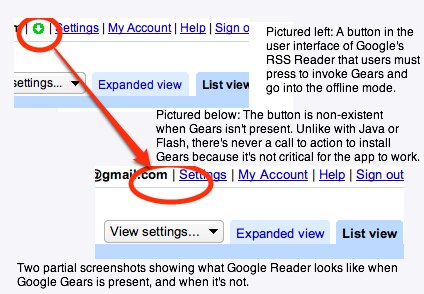
Even worse (in terms of getting a technology like Gears into the
fabric), the option to invoke the Gears-driven offline mode of a Web
application like Google Reader isn't even available as an option unless
Gears is locally installed (as seen in the bottom part of the above
graphic). The net net is that Gears isn't the easiest technology to
ubiquitously deploy into the fabric of the Web.
Enter Chrome (and its open source nature).
Most people missed it. But originally, the download for Google's Chrome browser was associated with Gears on Google's Web site.
Today, to get the functionality of Gears in one of the main three
browsers (Internet Explorer, FireFox, or Safari), it must be added-on
separately by the end-user. With Chrome, it won't be an add on. It will
be a foundational element of the browser.
Last week, I juxtaposed the comments
from the executives at Google and Mozilla to show that, when it came to
browser fundamentals, Google and Mozilla were not seeing eye-to-eye on
something (or probably multiple things). My guess is that Google sees
an offline technology like Gears as being so fundamental to the future
of Web applications, that it can't not be built into the browser. The
folks at Mozilla (where Gears is an add-on t the browser), on the other
hand, probably didn't see it that way.
I'm speculating here, but, from Google's point-of-view, if it gets
built into the various browsers, making Gears a part of the Web's
fabric the way HTML renderers or Javascript engines are a part of the
fabric is no longer a problem. That's one reason Google open-sourced
it: to encourage unencumbered adoption. It's one of the main reasons
that any vendor would open-sources anything. From the Mozilla
Foundation's point of view (in my opinion), building a vendor-provided
technology like Gears into FireFox (as opposed to requiring the add-on
approach) sets a precedent that the Foundation must be careful about
setting. If Gears, then why not Flash? Or Java?
There are probably technical reasons it makes more sense for Gears
to be a foundational element of the browser rather than an add-on. My
guess is that it offers more stability and reliability, particularly in
a partitioned environment where, like in Chrome, tabs are actually
separate instances of the browser.
So, what does any of this have to do with mobile developers. If
there's one environment that's super duper sensitive to both the
presence and peformance of the network, that environment, as stated
earlier is the mobile Web browser. Going back to Google founder Larry
Page's statements about Chrome, he mentioned the need for speed. In a
mobile environment, a technology like Gears is really just a cache and,
in the technology world, caches are more commonly associated with
performance than they are with the off-line mode of a browser.
Technically speaking, there's no reason a technology like Gears can't
be seamlessly working in the background all the time so that a mobile
browser can fetch the next thing it needs from that cache instead from
the slow and/or non-present network.
Let' say the two biggest reasons mobile developers are choosing to
build locally stored and executed applications instead of mobile
browser-based applications are speed and performance. Now let's say
both of those challenges can be addressed by the presence of a standard
caching technology like Gears in the majority of the mobile browsers
found in many of the future's handsets. As a developer looking to
access as much of the market as possible with a single code-base, your
first choice would have to be to develop for the browser first. Not
only does this give you access to the broadest part of the mobile
market, it gives that same application access to the desktop/notebook
market too (where the fabric is really no different).
One counter-argument to this is that there is a software development
kit for Android much the same way there's one for the other mobile
operating systems and that its presence encouraqes developers to go the
platform-specific route rather than the Web route. But in the big
picture, Google has no interest in limiting the availability of its
cloud to Android handsets. Google wins much bigger so long as end-users
perceive mobile Web apps to be fast and reliable and, by way of mobile
browsers, more users have fast and reliable access to Google's Web
apps.
One of the best ways to create that perception (and reality) is to
get more mobile developers building for the Web instead of any specific
platform. It's a win for developers looking to reach the broader
market. It's a win for end-users who shouldn't be forced into picking a
specific platform or network (eg: iPhone/AT&T) just to get access
to certain applications. It's a win for Google. Who is it not good for?
You don't have to look far.
Subscribe to:
Posts (Atom)