Wednesday, December 17, 2008

Why Intel Could Rock the Electric Vehicle Battery Market

Like any emerging industry, the cleantech world tends to accuse newcomers of being interlopers, and that's probably the initial thought many had when news hit that former Intel chairman and plug-in advocate Andy Grove is advising the company to move into the electric vehicle (EV) battery market. Realistically, what could the world's largest chipmaker, which makes the bulk of its revenues on digital communication technology, do to help transform our beleaguered car industry into an electric wunderkind?


A lot, actually. While the move would be risky, it could have a monumental effect on the slow-moving electric vehicle battery industry, particularly in the U.S.


Intel has already moved closer to the EV battery market with some recent investments through its venture arm, Intel Capital. The investment group has funded battery, energy storage, and alternative energy companies including the solid-state battery startup Cymbet, fuel-cell membrane company PolyFuel, and Chinese flow-battery maker Net Power Technology. Intel Capital's solar investments—like SpectraWatt, SulfurCell and Trony Solar—are also tied to batteries, as solar production needs to store energy overnight when the sun doesn't shine.


"We certainly consider battery technology important," Intel spokeswoman Christine Dotts told us. "Whether we will do anything more in this area we can't say at this time. However, it should be noted that battery technology developments for computer uses and for automotive applications are not necessarily mutually exclusive." That means if Intel does put significant efforts into battery development, the company believes it could use those innovations for computing, mobile technology, and networks (all industries where Intel already has a significant presence), not just transportation.


Intel certainly has the balance sheet to make large research and development bets. For the fourth quarter, Intel is expecting revenue of $9 billion, and for 2007, Intel generated $38.33 billion in revenue. Last year Intel spent $5.76 billion, or a whopping 15.03 percent of revenues for the year, on R&D.


At the same time, the market itself is crying out for an aggressive, smart company to solve some of electric vehicles' fundamental issues. The battery is one of the most expensive and technically difficult aspects of EVs, and it's one of the biggest reasons there are so few electric vehicles on our roads. As Rob Enderle from the research firm Enderle Group says: "Battery technology has significantly lagged," while other technologies have advanced. Most of the next-generation battery technology from startups like A123 Systems and Altair Nano, or energy storage devices like EEstor's, are still years away from commercialization.


continues : http://www.businessweek.com/

AMD Rallies in Effort to Reinvent Itself


Next year will be critical for Advanced Micro Devices, as the chip company pursues two major initiatives designed to reverse its financial losses and compete better with industry leader Intel.


To narrow losses, AMD this year cut staff and divested its digital TV assets to focus on profitable markets, including the graphics space through its ATI acquisition in 2006. It also announced that it would spin off its manufacturing assets to become a fabless company and appointed Dirk Meyer as CEO to revitalize the company's efforts to become more competitive in the microprocessor market.


However, the company earlier this month dropped its fourth-quarter revenue expectations, citing weaker-than-expected global demand for its products, especially in the consumer space. It joined other chip companies struggling due to a slowdown in PC demand and constrained budgets, including rival chip-makers Intel and Texas Instruments.


AMD in October announced that it would focus on chip design and spin off its chip manufacturing operations to a new company temporarily called The Foundry Co. The original plan called for AMD to have a 44.4 percent stake in the new company, with the rest owned by Advanced Technology Investment Company (ATIC), a fund owned by the Abu Dhabi government. Terms of the agreement were renegotiated last week, dropping AMD's ownership to a 34.2 percent stake, with the rest going to ATIC. In addition, another Abu Dhabi fund, Mubadala Development Company, will pay less for its stake in AMD than originally agreed upon, according to the renegotiated terms.


Spinning off the fabs helps AMD reduce expenditure and concentrate on chip design to deliver products competitive with Intel's offerings. It also helps AMD unload debt of US$1.2 billion, which will be assumed by the spin-off. The deal, which closes early next year, will also send AMD's two fabrication facilities in Dresden, Germany, to the new company.


However, spinning off the fabs into a separate company has its risks. AMD could lose its independence in chip development, as it will have no fab to test and fine-tune processors while adding more features to smaller chips.


That could put AMD at a disadvantage over Intel, which owns fabs and is a generation ahead in manufacturing technology, said Jack Gold, principal analyst at J. Gold Associates. Intel launched chips manufactured using the 45-nanometer process in 2007, close to a year ahead of AMD's first offering of chips manufactured using the 45-nm process.


AMD can hope for a quick recovery of the PC market and keep its chip road map afloat next year to remain competitive with Intel, Gold said. It will also need to overcome design challenges by coordinating its chip design efforts with the company manufacturing the chips.


The Foundry Co. may initially focus manufacturing efforts on AMD's chips, but it may not remain exclusive as the spin-off tries to expand its market presence. "Changing a fab is a long and expensive process, so it won't happen overnight," Gold said.


PC makers are not worried about AMD becoming a fabless company, as long as the company meets its chip road map, said Kelt Reeves, CEO of Falcon Northwest, a PC maker.


"As long as the inventory shows up when we need it, who owned the fab it was made in is a non-issue," Reeves said.


After years of inconsistency in delivering chips on time, AMD got back on track in the chip space this year, fixing bugs, releasing the Barcelona server chip and rolling out its Shanghai server chip ahead of schedule. It also revealed a consumer-chip road map late in the year to create excitement around its new products.


But in the new road map, the company revealed that it had delayed the launch of its much-awaited Fusion family of chips, which would combine a graphics processing unit and CPU on a single chip. That impacted PC makers and consumers, who were eagerly awaiting the release of the breakthrough chip.


The CPU and GPU components will now be combined in chips code-named Llano and Ontario, which will be released in 2011. The company will get better economies of scale and power savings from the chips manufactured using the 32-nm process.


AMD may have delayed the 45-nanometer chips because it didn't foresee the design challenges, said Rob Lineback, senior market research analyst at IC Insights.


"AMD clearly faced technical and economic challenges in combining central processing units with graphics units at the current 45-nanometer process generation," Lineback said.


On the flip side, delaying Fusion chips may help AMD reap financial benefits of the stand-alone GPU business, which is profit-making and generates a good chunk of AMD's revenue, Lineback said. If released as originally planned, Fusion chips would have reduced the need for separate graphics cards, cannibalizing the sales of ATI graphics cards. That allows AMD to keep the CPU and GPU business, which will help the company.


AMD is doing well in the GPU market, as it understands the needs of enthusiast clients like gamers who buy graphics cards, Reeves said. For being a small player, AMD took a large chunk of the graphics-card market share away from Nvidia and other companies with the launch of its ATI Radeon 4800 series graphics chips this year.


"It was a massive turnaround, and it's just a reminder to never count any major player out in this market," Reeves said.


However, it remains unclear whether progress in the GPU space and conversion to a fabless company will quickly move AMD into a profitable position. With PC sales tanking worldwide, there is no quick fix to escape the economic downturn, Gold said.


"This is definitely affecting AMD as well as Intel, which also has provided the market with some cautious statements about business for the next few quarters. If it's going to take over a year or two years for the market to recover, AMD could be hurting for a while," Gold said.


source : http://www.pcworld.com/

ASUS demos Xonar HDAV1.3 HDMI Deluxe sound card

One might assume that it'd be easy to forget a device that was introduced way back at the front end of this year, but for HTPC owners looking for a reliable way to bitstream Dolby TrueHD and DTS-HD Master Audio via HDMI, this one would be impossible to shake from the memory bank. Reportedly, the card went on sale (at least in some parts of the globe) this September, but early adopters were deeply saddened by the unit's inability to bitstream. Thankfully, ASUS has heard the weeping, and it has conjured up new drivers (and the Xonar HDAV1.3 HDMI Deluxe) in order to remedy the issue. The crew at TweakTown was able to video a live demonstration in Taiwan, and they came away emphatically impressed. Shoot on down to the read link for a look at what they found.


Source : http://www.engadgethd.com/

Boring Netbook with a great battery? Meet the Samsung NC10

At first glance, Samsung's take on the traditional 10-inch Netbook is about as bland as these tiny little systems get. It lacks the big keyboard of HP's Mini 1000 or the ExpressCard slot of the Lenovo S10, and if you stuck it in a lineup with Netbooks from Acer and MSI, you'd be hard-pressed to pick it out.


The NC10 does, however, have one of the best batteries we've seen in a Netbook, second only to the current 9- and 10-inch Eee PC models from Asus. With about five hours from a not-too-bulky 6-cell battery, it's a good choice for long flights or extended coffee shop sessions.


Read the full review of the Samsung NC10.


Source : http://news.cnet.com/

ASUS Debuts Notebook - Eee 10.2? Mini PC Notebook

Asus with its Eee PC mini notebook concept made a great move, starting avalanche that still spreads. Almost there is no big manufacturer of notebooks on market that didn’t launch or announced similar product. Besides huge popularity that Asus Eee PC 701 got, there were some objections which dissuaded a lot of potential buyers from shopping. Most criticism was targeted to its screen size. Even on Eee’s concept promotion was announced launch of bigger model, but waiting for it got prolonged more than we expected. Finally, we are in position to introduce Asus Eee 10.2" mini PC notebook to you.

If you, by any chance, aren’t familiar with its predecessor we suggest you to first read our review for 10.2" mini PC notebook. Quite expected, Eee 10.2" mini PC notebookdoesn’t bring anything revolutionary but improvements that are implemented were carefully chosen. The 10.2" mini PC notebook has 10.2" diagonal screen and 1024×600p resolution. Everyday work and above all surfing on the Internet is now incomparably cozier. Most sites are optimized for 1024p horizontal resolution and on new model horizontal scroll is eluded during site checkups. Also considerably reduced is need for vertical scrolling. This resolution is much more pleasant not only for surfing but also for regular text typing.

This time ASUS applied LED display with less consumption that offers more reliable and uniform black color from classic displays. We should mention that screen is matte, to everyone’s pleasure. Picture is bright and clear, while on strong sun light you will need to set higher screen brightness value. As we tested engineer sample, we can only hope that final product will improve that characteristic. Anyway, bigger screen means a lot and Asus Eee10.2" mini PC notebook got a big plus for that. The best thing is that Asus just slightly changed dimensions in total. Weight went up to 1.25KG

This Eee PC offers even more options to users for unique user experiences. Users will be able to enjoy stable and reliable computing on-the-go; Super  VIA C7-Mobile processor 1.6G Hz and 1GB DDR2 RAM, 4 hours of battery life, high speed 802.11b/g connectivity and exclusive 120GB Storage makes it the ideal traveling companion for outdoor activities. The large 10.2" display provides comfortable viewing, and a keyboard that’s 92% sized of generic notebooks make for easier typing and relaxing usage. It is also available in 6 custom colored designs to fit your unique personality.


Source : http://www.prlog.org/

Sony Readies Another PlayStation Portable Iteration, PlayStation Portable Successor to Come Later.

Sony Computer Entertainment Inc. is preparing a yet another version of its PlayStation Portable (PSP) video game console for the launch next year, whereas the next-generation PlayStation Portable will only be released at a later point.


The model PSP-4000, the fourth version of Sony PSP and the third slim-and-lite flavour of the portable console, will be released in late 2009, “publishing sources” revealed in an interview with EuroGamer web-site. Meanwhile, the true next-generation portable game system will be released at a later time.


Back in November rumours transpired that Sony had licensed PowerVR graphics processor technologies for the next-gen PSP2. If the information was correct, then in the best case scenario the PlayStation Portable 2 will see the light of the day in late 2010, but it is highly likely that it will be launched sometime in 2011.


As many other companies, SCEI does not comment on future products, currently developed technologies and market rumours. Therefore, it is impossible to verify anything about the PSP2 at this point. In fact, a high-ranking Sony Executive said that there is no PSP2 even in the plans.


“There are currently no plans for a PSP2. I go to Tokyo quite a lot and no one has referred to it – I think they have their hands full at the moment,” said David Reeves, president of Sony Computer Entertainment Europe, in an interview with MCV web-site.


It may not be crucial for Sony to release its next-generation PSP. The current device provides decent amount of features and performance that will be relevant for a year or two at least. Meanwhile, leaving the next-gen console without certain technologies that will be demanded in five to six years time is something that Sony is unlikely to do.


Source : http://www.xbitlabs.com/

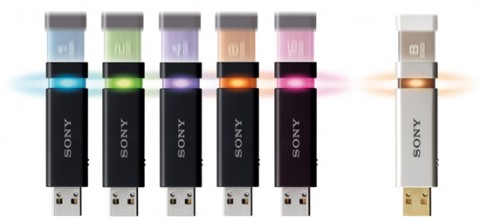
Sony releasing movies and music on USB flash drives

Lately large entertainment companies have been pushing virtual copies of their movies for portable media players (PMP) such as Apple’s iPod Touch. Sony has announced another way that they are going to distribute these virtual copies to consumers.


12-16-08-sony-microvault-cl-480x221


Sony will be releasing digital copies of movies and albums on USB flash drives. Everyone could use a flash drive or two but just how many is to many? Michael Jackson fans can pickup the 25th Anniversary of the thriller album for only $19.99, or feature films for $29.99 each. Sony has not commented on whether or not there will be any added special features to these titles.


Other than portability, I don’t see why people would pay $29 for a movie that is on a USB flash drive when they can pay the same amount for a Blu-ray copy and then later copy it to the drive if they wish.  As for music titles it just simply wont work. Downloading music from iTunes is just far too easy to do these days. We are sure that for $19 most people would rather have the physical CD rather than a USB drive.


Source : http://www.slashgear.com/