Google announced on Friday that it is acquiring AppJet, a small startup with a focus on real-time online document collaboration. The AppJet team will be relocating "down under" to join the Google Wave team in Australia and help redefine "real-time" collaboration.
Many of the AppJet team formerly worked for Google according to the AppJet Web site. Chief executive officer Aaron Iba used to write algorithms for improving search quality, chief operating officer Daniel Clemens was an associate product manager, and chief technology officer J.D. Zamfirescu left Google as well.
Really Real-Time
AppJet has developed a unique approach to updating the shared display as different contributors type with its EtherPad tool. According to the EtherPad site "EtherPad is the only web-based word processor that allows people to work together in really real-time."
AppJet's EtherPad product has been compared with Google Docs. Both provide online, collaborative document editing. The EtherPad FAQ illustrates the distinctions between the two, though. "Google Docs is a suite of products that do many things, from word processing to spreadsheets to document management. One thing that Google Docs does not do is real-time collaborative text editing."
It goes on to explain that "with Google Docs it takes about 5 to 15 seconds for a change to make its way from your keyboard to other people's screens. Imagine if whiteboards or telephones had this kind of delay! In contrast, the EtherPad infrastructure is built to carry your every keystroke at the speed of light, limited only by the time it takes electrons to travel over a wire (such as an "ethernet" cable)."
I use the Google Docs spreadsheet and I can attest to the fact that the delay can sometimes cause conflict and confusion. While each of us sharing the spreadsheet have our own unique color that highlights the field we are currently working in, those 5 seconds are enough to allow for multiple contributors to write in the same filed--overwriting each other. He who types last wins.
Raising the Bar
The speed at which real-time changes are reflected on the shared page is arguably the most important technology that AppJet brings to Google, but there are other aspects of online collaboration that AppJet does better than Google as well.
EtherPad 'pads' can be shared by simply sending a link. Google Docs requires that all collaborators have Google Docs accounts and involves sending an email to invite users to join in sharing a doc.
EtherPad clearly highlights each user's contributions with a unique background color which makes it much less confusing to determine who wrote what. Google Docs has an "undo" feature, but the ability to undo an action lasts only until someone else changes something. EtherPad provides limitless "undo" capabilities.
Adding a Ripple to Google Wave
AppJet has a lot to offer for the ongoing development of Google Wave. The initial demo of Google Wave was very impressive and resulted in a lot of speculation and anticipation of what Google Wave may deliver.
Google Wave merges e-mail, instant messaging, online collaboration, and document sharing in one. If it can live up to the hype and expectations, Google Wave threatens to be a game changer for online collaboration, and possibly for unified communications as well.
The beta of Google Wave has had a fairly tepid reception, though. Users begged and pleaded for invites to join the Google Wave beta only to receive them and sign up and say "is this it?"
Combining the technology behind EtherPad's "pads" with Google Wave's "waves" will help boost Wave's functionality and move Google a step closer to delivering a robust platform capable of revolutionizing online communication.
http://www.pcworld.com/businesscenter/article/183805/google_redefines_realtime_collaboration_with_appjet_purchase.html
Sunday, December 6, 2009
Apple’s Game Changer, Downloading Now
IAN LYNCH SMITH, a shaggy-haired ball of energy in his late 30s, beams as he ticks off some of the games that Freeverse, his little Brooklyn software company, has landed on the iPhone App Store’s coveted (and ever-changing) list of best-selling downloads: Moto Chaser, Flick Fishing, Flick Bowling and Skee-ball.
Skee-ball, Mr. Smith says, took about two months to develop and deploy and then raked in $181,000 for Freeverse in one month. The company’s latest bid for App Store fame? A game featuring a Jane Austen character in a lacy dress who karate-chops her way through hordes of advancing zombies.
“There’s never been anything like this experience for mobile software,” Mr. Smith says of the App Store boom. “This is the future of digital distribution for everything: software, games, entertainment, all kinds of content.”
As the App Store evolves from a kitschy catalog of novelty applications into what analysts and aficionados describe as a platform that is rapidly transforming mobile computing and telephony, it is changing the goals and testing the patience of developers, bolstering sales of the Apple motherships the applications ride upon — the iPhone and iPod Touch — and causing Apple’s competitors to overhaul their product lines and business models. It even threatens to open chinks in Apple’s own corporate armor.
Thanks in large part to the iPhone, introduced in 2007, and the App Store, which opened its doors last year, smartphones have become the Swiss Army knives of the digital age.
They provide a staggering arsenal of functions and tools at the swipe of a finger: e-mail and text messaging, video and photography, maps and turn-by-turn navigation, media and books, music and games, mobile shopping, and even wireless keys that remotely unlock cars.
“Apple changed the view of what you can do with that small phone in your back pocket,” says Katy Huberty, a Morgan Stanley analyst. “Applications make the smartphone trend a revolutionary trend — one we haven’t seen in consumer technology for many years.”
Ms. Huberty likens the advent of the App Store and the iPhone to AOL’s pioneering role in driving broad-based consumer adoption of the Internet in the 1990s. She also draws comparisons to ways in which laptops have upended industry assumptions about consumer preferences and desktop computing. But, she notes, something even more profound may now be afoot.
“The iPhone is something different. It’s changing our behavior,” she says. “The game that Apple is playing is to become the Microsoft of the smartphone market.”
The popularity of Apple’s app model has reached a fever pitch. Tens of thousands of independent developers are clamoring to write programs for it, and the App Store’s virtual shelves are stocked with more than 100,000 applications. Apple recently said that consumers had downloaded more than two billion applications from its store.
Major players like Research in Motion (maker of the BlackBerry), Palm (maker of the Pre), Google (maker of the Android mobile operating system) and Microsoft (maker of Windows Mobile) are taking note and scrambling to replicate the App Store frenzy.
App fever has even prompted cities like New York and San Francisco to open reservoirs of city data to the public to spur software developers to create hyperlocal applications for computers and phones.
One need not look further than the lobby of Apple’s headquarters in Cupertino, Calif., to see that the iPhone and applications that run on it are centerpieces of the company’s mobile strategy. Planted squarely in the lobby of the main office, at 1 Infinite Loop, is an impressive, 24-foot-wide array built out of 20 LED screens populated with 20,000 tiny, brightly colored icons.
As Philip W. Schiller, head of worldwide product marketing at Apple, describes how the wall works — each time an application is purchased, the corresponding icon on the electronic billboard jiggles, causing its neighbors to ripple in unison — he, too, becomes animated.
Normally reserved and on message, Mr. Schiller waves his hands back and forth and allows his voice to ascend into giddy registers as he speaks about the potential unleashed by the App Store.
“I absolutely think this is the future of great software development and distribution,” Mr. Schiller says. “The idea that anyone, all the way from an individual to a large company, can create software that is innovative and be carried around in a customer’s pocket is just exploding. It’s a breakthrough, and that is the future, and every software developer sees it.”
APPLE cloaks most of its inner workings in a shroud of secrecy — a tactic that has helped preserve the company’s mystique and generate intense interest in its product rollouts.
But the App Store relies on vast cadres of outside developers to populate its virtual shelves with products, leaving Apple in the unfamiliar and at times uncomfortable position of having to collaborate with folks who haven’t drunk the company’s corporate Kool-Aid.
This has led Apple to be deeply supportive of developers once shunned by big telecommunications companies, while also frustrating many of them more recently with what developers see as the company’s inscrutable and arbitrary process for accepting programs into the App Store.
Apple frames the issue differently.
http://bit.ly/798BnO
Skee-ball, Mr. Smith says, took about two months to develop and deploy and then raked in $181,000 for Freeverse in one month. The company’s latest bid for App Store fame? A game featuring a Jane Austen character in a lacy dress who karate-chops her way through hordes of advancing zombies.
“There’s never been anything like this experience for mobile software,” Mr. Smith says of the App Store boom. “This is the future of digital distribution for everything: software, games, entertainment, all kinds of content.”
As the App Store evolves from a kitschy catalog of novelty applications into what analysts and aficionados describe as a platform that is rapidly transforming mobile computing and telephony, it is changing the goals and testing the patience of developers, bolstering sales of the Apple motherships the applications ride upon — the iPhone and iPod Touch — and causing Apple’s competitors to overhaul their product lines and business models. It even threatens to open chinks in Apple’s own corporate armor.
Thanks in large part to the iPhone, introduced in 2007, and the App Store, which opened its doors last year, smartphones have become the Swiss Army knives of the digital age.
They provide a staggering arsenal of functions and tools at the swipe of a finger: e-mail and text messaging, video and photography, maps and turn-by-turn navigation, media and books, music and games, mobile shopping, and even wireless keys that remotely unlock cars.
“Apple changed the view of what you can do with that small phone in your back pocket,” says Katy Huberty, a Morgan Stanley analyst. “Applications make the smartphone trend a revolutionary trend — one we haven’t seen in consumer technology for many years.”
Ms. Huberty likens the advent of the App Store and the iPhone to AOL’s pioneering role in driving broad-based consumer adoption of the Internet in the 1990s. She also draws comparisons to ways in which laptops have upended industry assumptions about consumer preferences and desktop computing. But, she notes, something even more profound may now be afoot.
“The iPhone is something different. It’s changing our behavior,” she says. “The game that Apple is playing is to become the Microsoft of the smartphone market.”
The popularity of Apple’s app model has reached a fever pitch. Tens of thousands of independent developers are clamoring to write programs for it, and the App Store’s virtual shelves are stocked with more than 100,000 applications. Apple recently said that consumers had downloaded more than two billion applications from its store.
Major players like Research in Motion (maker of the BlackBerry), Palm (maker of the Pre), Google (maker of the Android mobile operating system) and Microsoft (maker of Windows Mobile) are taking note and scrambling to replicate the App Store frenzy.
App fever has even prompted cities like New York and San Francisco to open reservoirs of city data to the public to spur software developers to create hyperlocal applications for computers and phones.
One need not look further than the lobby of Apple’s headquarters in Cupertino, Calif., to see that the iPhone and applications that run on it are centerpieces of the company’s mobile strategy. Planted squarely in the lobby of the main office, at 1 Infinite Loop, is an impressive, 24-foot-wide array built out of 20 LED screens populated with 20,000 tiny, brightly colored icons.
As Philip W. Schiller, head of worldwide product marketing at Apple, describes how the wall works — each time an application is purchased, the corresponding icon on the electronic billboard jiggles, causing its neighbors to ripple in unison — he, too, becomes animated.
Normally reserved and on message, Mr. Schiller waves his hands back and forth and allows his voice to ascend into giddy registers as he speaks about the potential unleashed by the App Store.
“I absolutely think this is the future of great software development and distribution,” Mr. Schiller says. “The idea that anyone, all the way from an individual to a large company, can create software that is innovative and be carried around in a customer’s pocket is just exploding. It’s a breakthrough, and that is the future, and every software developer sees it.”
APPLE cloaks most of its inner workings in a shroud of secrecy — a tactic that has helped preserve the company’s mystique and generate intense interest in its product rollouts.
But the App Store relies on vast cadres of outside developers to populate its virtual shelves with products, leaving Apple in the unfamiliar and at times uncomfortable position of having to collaborate with folks who haven’t drunk the company’s corporate Kool-Aid.
This has led Apple to be deeply supportive of developers once shunned by big telecommunications companies, while also frustrating many of them more recently with what developers see as the company’s inscrutable and arbitrary process for accepting programs into the App Store.
Apple frames the issue differently.
http://bit.ly/798BnO


Apple Has Acquired Lala
Earlier today we covered rumors that Apple was in talks to acquire streaming music service Lala. Now New York Times tech reporter Brad Stone has tweeted that it's a done deal. He writes, "Apple has acquired digital music startup Lala. Now updating our story". You can find the NYT story here.
This could be bad news for Lala users. It's unlikely that the innovative deals negotiated by Lala will survive through the acquisition. For over a year, Lala users have been purchasing the rights to stream their music an unlimited number of times for ten cents per song. If the deals with the music labels go up in smoke, Lala may lose the right to stream those songs. In other words, all the money users have been spending on web songs may go down the drain. If the deals are nullified, hopefully Apple will renegotiate them to at least cover existing purchases until it releases its own streaming music service. We've reached out to Lala but have yet to hear back.
Likewise, this may well affect the Lala music gifts that have been recently offered by Facebook, and it could also harm the Music OneBox service Google recently launched (though Google can still rely on MySpace/iLike for its song streams).
Stone writes that Apple is interested in Lala because of its engineering talent and technology, and that it was Lala that initiated the discussions. From the Times:
One person with knowledge of the deal, but who was not authorized to discuss it, said that the negotiations originated when Lala executives concluded that their prospects for turning a profit in the short term were dim and initiated discussions with Eddy Cue, Apple?s vice president in charge of iTunes.This person said Apple would primarily be buying Lala?s engineers, including its energetic co-founder Bill Nguyen, and their experience with cloud-based music services.
The deal makes sense. It seems inevitable that Apple will eventually launch its own cloud-based streaming music service. And that's exactly what Lala is ? an iTunes in the cloud, with some interesting pricing mechanics.
A few other interesting things to note. This acquisition comes a little more than a month after Lala was integrated into Google's OneBox and Facebook's gift store. Lala may well have been viewing these launches as last-chance efforts to find a path to profitability. Given these reports that Lala's "prospects for turning a profit in the short term were dim", it looks like those launches may not have gone as well as Lala hoped.
http://bit.ly/6Mhqnb
This could be bad news for Lala users. It's unlikely that the innovative deals negotiated by Lala will survive through the acquisition. For over a year, Lala users have been purchasing the rights to stream their music an unlimited number of times for ten cents per song. If the deals with the music labels go up in smoke, Lala may lose the right to stream those songs. In other words, all the money users have been spending on web songs may go down the drain. If the deals are nullified, hopefully Apple will renegotiate them to at least cover existing purchases until it releases its own streaming music service. We've reached out to Lala but have yet to hear back.
Likewise, this may well affect the Lala music gifts that have been recently offered by Facebook, and it could also harm the Music OneBox service Google recently launched (though Google can still rely on MySpace/iLike for its song streams).
Stone writes that Apple is interested in Lala because of its engineering talent and technology, and that it was Lala that initiated the discussions. From the Times:
One person with knowledge of the deal, but who was not authorized to discuss it, said that the negotiations originated when Lala executives concluded that their prospects for turning a profit in the short term were dim and initiated discussions with Eddy Cue, Apple?s vice president in charge of iTunes.This person said Apple would primarily be buying Lala?s engineers, including its energetic co-founder Bill Nguyen, and their experience with cloud-based music services.
The deal makes sense. It seems inevitable that Apple will eventually launch its own cloud-based streaming music service. And that's exactly what Lala is ? an iTunes in the cloud, with some interesting pricing mechanics.
A few other interesting things to note. This acquisition comes a little more than a month after Lala was integrated into Google's OneBox and Facebook's gift store. Lala may well have been viewing these launches as last-chance efforts to find a path to profitability. Given these reports that Lala's "prospects for turning a profit in the short term were dim", it looks like those launches may not have gone as well as Lala hoped.
http://bit.ly/6Mhqnb
What Apple's LaLa Acquisition May Mean for iTunes
Apple has struck a deal to buy the streaming and downloading music Web site LaLa.com, according to reports from the New York Times and Wall Street Journal. It would add to Apple's music empire, but how might this acquision change Apple's tune?
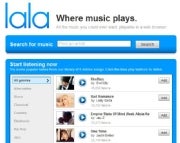
Lala (click to enlarge the screen shot) gives users the option of downloading MP3s for 89 cents each or (this is where things get interesting) buy a stream-only version of the song for ten cents or an entire album for a dollar or so.
 The New York Times' unnamed source says talks initiated with Apple after Lala executives determined the service wouldn't be profitable in the near future. The source said Apple was more interested in buying the people behind Lala's streaming service and their experience than the service itself.
Lala started as a CD swapping service and morphed into a music hub before it joined forces with major music labels and launched the streaming and downloading service. In October, Lala made a deal with Google to become a part of its music search, which allowed searchers to preview songs directly in Google search results.
The increase in popularity of streaming music services such as Pandora, Rhapsody and Grooveshark, and streaming m
Apple Spokesman Steve Dowling told the New York Times that Apple generally doesn't sharing its purpose or plans when purchasing a small tech company -- but that doesn't mean we can't make a wish list for what we want out of the deal.
Lala's claim to fame is a streaming song for a dime or a Web album for a dollar. Let's face it, with more and more iTunes users toting around iPhones and iPod Touches with less storage space, more Apps and 3G or WiFi connections, streaming music might be a viable model for the future of iTunes.
 In 2008 Steve Jobs famously called Blu-Ray a "bag of hurt" partially because of its complex technology licenses and consumers lack of support for the HD disc at the time. Apple embraced HD streaming options on the Apple TV and iTunes; why not extend to streaming music?
Listening to a whole song instead of a predetermined 30-second snippet can prevent buyers from purchasing a song that sounds good in the previews but ends up being three minutes of blah with a catchy chorus.
Apple always had a following for its products' ease of use and quality. Instead of forcing people to use the Apple streaming service on Apple hardware, Apple should continue supporting existing music applications and rely on quality and ingenuity to ensure its solution gets used.
http://bit.ly/5XO0L7
Lala (click to enlarge the screen shot) gives users the option of downloading MP3s for 89 cents each or (this is where things get interesting) buy a stream-only version of the song for ten cents or an entire album for a dollar or so.
 The New York Times' unnamed source says talks initiated with Apple after Lala executives determined the service wouldn't be profitable in the near future. The source said Apple was more interested in buying the people behind Lala's streaming service and their experience than the service itself.
Lala started as a CD swapping service and morphed into a music hub before it joined forces with major music labels and launched the streaming and downloading service. In October, Lala made a deal with Google to become a part of its music search, which allowed searchers to preview songs directly in Google search results.
The increase in popularity of streaming music services such as Pandora, Rhapsody and Grooveshark, and streaming m
Artwork: Chip Taylor
usic applications for iPhone and iPod Touch, left questions if Apple would join the streaming bandwagon.Apple Spokesman Steve Dowling told the New York Times that Apple generally doesn't sharing its purpose or plans when purchasing a small tech company -- but that doesn't mean we can't make a wish list for what we want out of the deal.
1. Cheaper Prices and Streaming Options
Obviously there isn't much forcing Apple to reconsider how it charges for MP3s, but a drop in prices or streaming options would be a welcome addition to iTunes.Lala's claim to fame is a streaming song for a dime or a Web album for a dollar. Let's face it, with more and more iTunes users toting around iPhones and iPod Touches with less storage space, more Apps and 3G or WiFi connections, streaming music might be a viable model for the future of iTunes.
In 2008 Steve Jobs famously called Blu-Ray a "bag of hurt" partially because of its complex technology licenses and consumers lack of support for the HD disc at the time. Apple embraced HD streaming options on the Apple TV and iTunes; why not extend to streaming music?2. Full Song Previews
Besides offering cheaper prices than iTunes and streaming options at its music store, Lala also allows users to preview entire songs. After listening to the entire song once, you can preview a 30-second clip before purchasing.Listening to a whole song instead of a predetermined 30-second snippet can prevent buyers from purchasing a song that sounds good in the previews but ends up being three minutes of blah with a catchy chorus.
3. Genius Radio
Apple has poured a lot of work into Genius. Steve Jobs equates the software to a personal DJ that makes playlists and recommends new songs based on your library. The feature works great, except that it is limited to your existing library or recommends new purchases for you to make. If a streaming subscription, or advertisement based service were created Genius could quickly turn into a behemoth challenger to Pandora, with the backing of Apple's oh-so-famous fanboys.4. Speaking of Pandora . . .
Let's not forget how badly the whole Google Voice App rejection went down. If Apple is indeed planning to venture into the streaming music world, one hopes it won't suddenly perceive currently supported Apps as iTunes revenue threats and reject them from the App Store.Apple always had a following for its products' ease of use and quality. Instead of forcing people to use the Apple streaming service on Apple hardware, Apple should continue supporting existing music applications and rely on quality and ingenuity to ensure its solution gets used.
http://bit.ly/5XO0L7
Subscribe to:
Posts (Atom)